


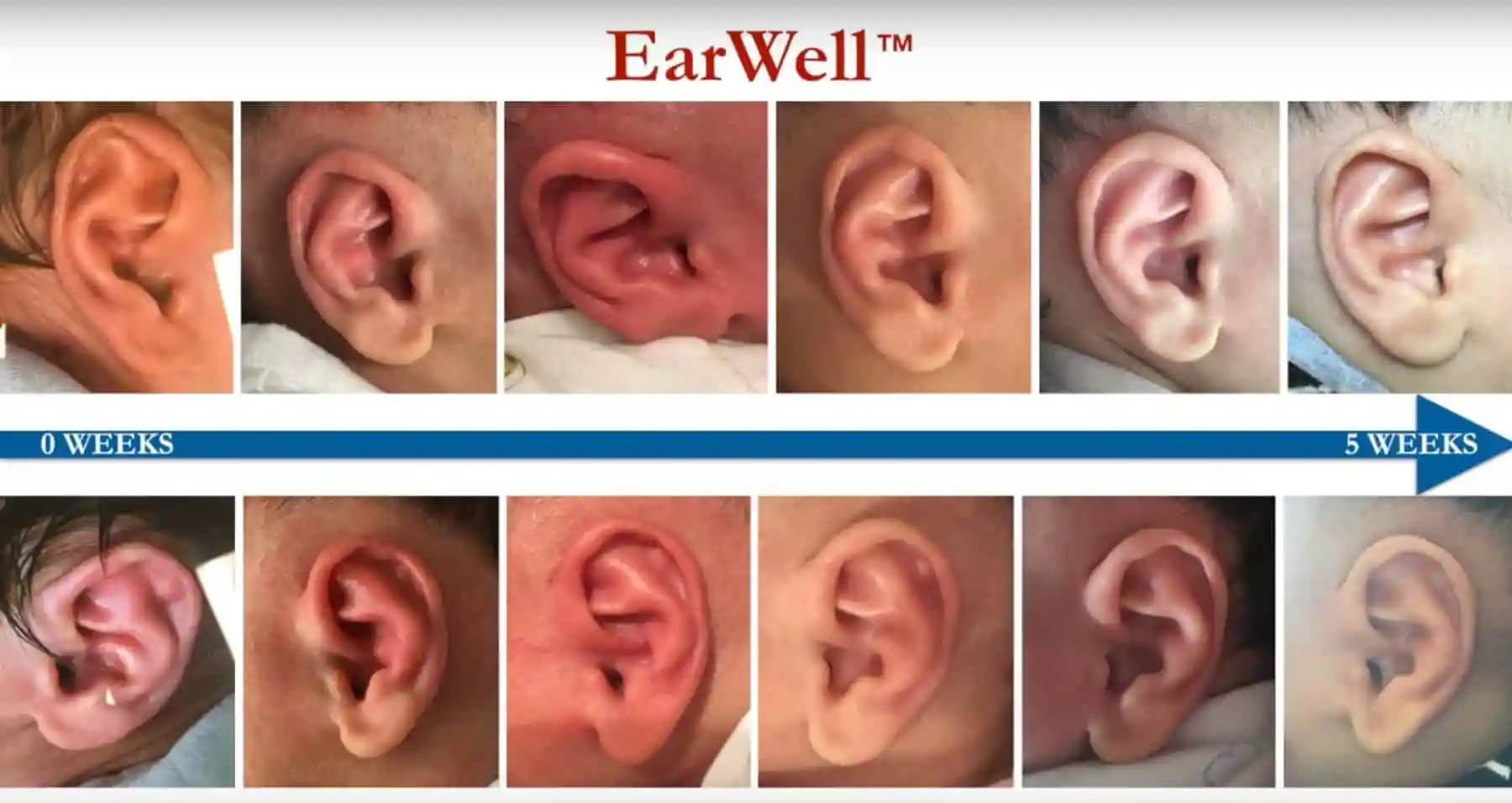
A Differently Shaped Ear at Birth?
When parents meet their newborn for the first time, they observe every detail with love and wonder.
Sometimes, one small detail catches their attention: an ear that appears more prominent, folded, smaller, asymmetrical, or unusually shaped.
The most common reaction is simple:
“Let’s wait a little. Maybe it will correct itself.”
Sometimes, that is true.
But sometimes, waiting means missing an exceptional opportunity.
An opportunity that exists only at the very beginning of life.
What Most Parents Do Not Know
During the first weeks after birth, the cartilage of the ear has a unique property.
It is naturally soft and malleable.
This short and precious period often makes it possible to correct certain congenital ear deformities using a non-surgical ear molding technique.
No surgery.
No anesthesia.
No pain.
No scar.
No hospitalization.
For many families, this information comes as a real discovery.
For decades, the only solution often offered was surgery several years later.
Today, when the anomaly is identified early enough, another option is often possible.
A Few Weeks Can Make All the Difference
In many medical specialties, a few weeks may not make a major difference.
Here, they can change everything.
With each passing week, the cartilage gradually loses its natural ability to be reshaped.
The treatment window slowly begins to close.
Then it disappears.
This is why specialists in this field do not first ask:
“Is the ear severely deformed?”
They ask:
“How old is the baby?”
Because time is often the most important factor for success.
A Consultation Commits You to Nothing. Waiting May Cost an Opportunity.
The purpose of an early consultation is not to treat every child.
The purpose is to know.
To know whether the shape observed is normal or not.
To know whether it is likely to persist.
To know whether correction is possible.
And most importantly, to know whether the child is still within the period during which this correction can be achieved simply.
In some cases, no treatment is needed.
In others, a few weeks of care can lead to a remarkable improvement.
But this decision must be made while all options are still open.
Sometimes Subtle, But Sometimes Lifelong
Among the most common situations are:
- Prominent ears
- Folded ears, also known as Lop Ear
- Constricted ears
- Absent or underdeveloped ear folds
- Stahl’s Ear
- Auricular asymmetries
- Other congenital deformities of the external ear
Some are very visible.
Others may seem minor.
But even a mild anomaly deserves to be assessed while a simple correction may still be possible.
Specific Expertise for Newborns and Infants
The assessment and treatment of congenital ear deformities require an in-depth understanding of auricular development in newborns, as well as specific experience with early ear molding techniques.
Dr. Olivia Benabu, pediatric ENT specialist in Jerusalem, supports families through this process with an approach based on medical precision, attentive listening, and prevention.
Every child is unique.
Every ear is different.
Every decision deserves a personalized evaluation.
The Message I Wish Every New Parent Could Hear
You do not need to know whether your baby needs treatment.
That is our role.
Your role is simply not to let the period during which treatment is still possible pass by.
If the shape of your child’s ear concerns you, even slightly, seek specialist advice quickly.
Maybe everything is normal.
Maybe no intervention will be necessary.
But if correction is indicated, the first weeks of life often represent the best chance of achieving the best result with the simplest treatment.
Dr. Olivia Benabu
Pediatric ENT Specialist – Jerusalem